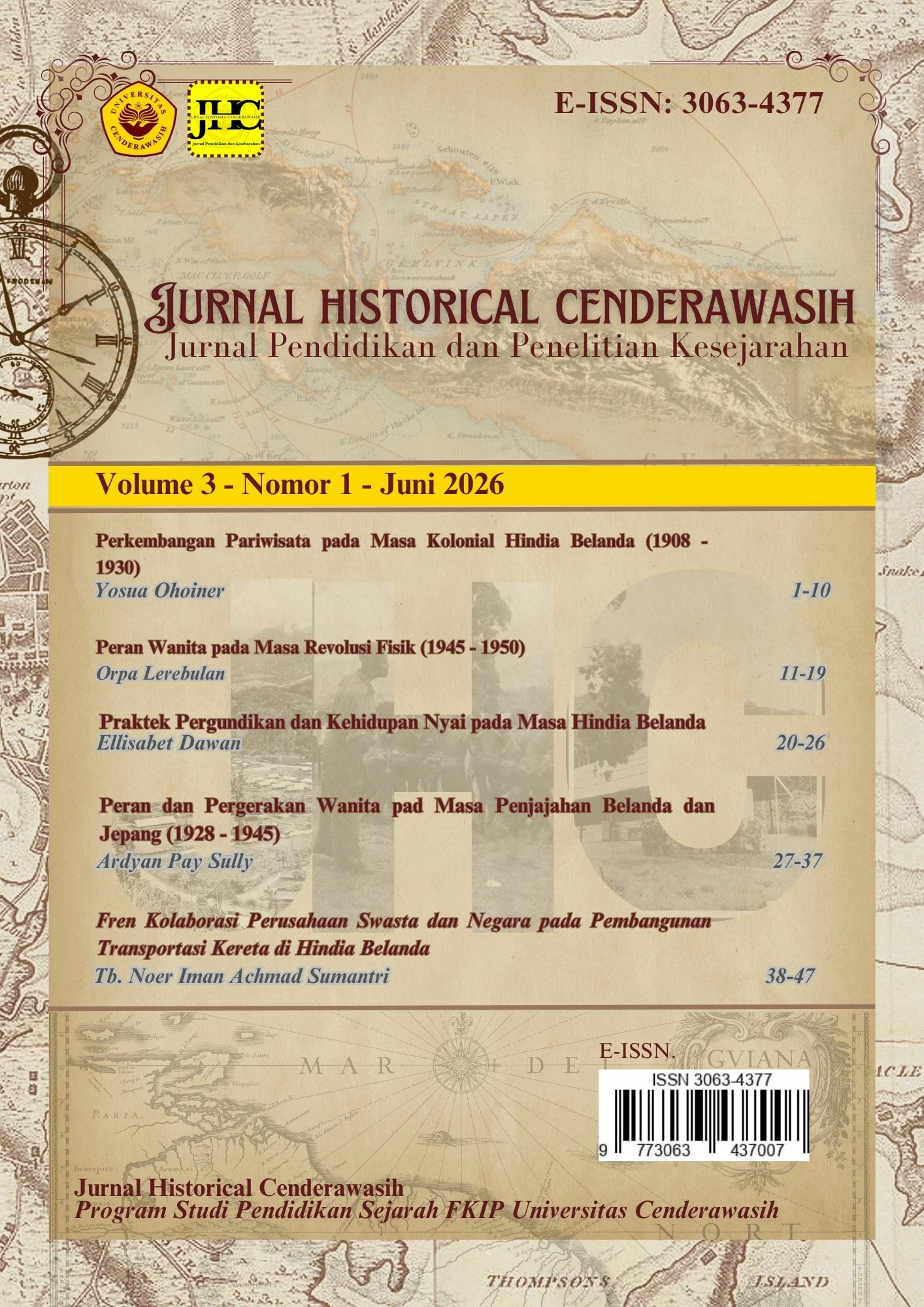
Perkembangan Pariwisata pada Masa Kolonial Hindia Belanda (1908-1930)
DOI:
https://doi.org/10.31957/jhc.v3i1.5896Keywords:
Tourism, Dutch East Indies, Vereeniging Toeristenverkeer, Transportation, Colonial HistoryAbstract
This historical study examines the development of tourism in the Dutch East Indies from 1908 to 1930. Utilizing the historical research method—encompassing heuristics, source criticism, interpretation, and historiography—this paper analyzes how the Dutch colonial government and private sectors transformed travel into an organized industry. The establishment of the Vereeniging Toeristenverkeer (VTV) in 1908 marked a significant milestone in promoting the colony as a safe, modern, and exotic tropical destination through travel guides, media publications, and international bureaus. Concurrently, advancements in transportation infrastructure, including steamship lines via the Koninklijke Paketvaart Maatschappij (KPM), railways managed by Staatsspoorwegen (SS), and early commercial aviation, significantly enhanced domestic connectivity. These developments drove the expansion of modern hotels and tourism services across key destinations such as Batavia, Bandung, Garut, Yogyakarta, and Bali. Ultimately, colonial tourism evolved into a structured economic sector that packaged native landscapes and cultures for European travelers while leaving a lasting legacy on modern Indonesian tourism infrastructure.
Downloads
Downloads
Published
Issue
Section
License
Authors who publish with Jurnal Historical Cenderawasih retain the copyright of their work.
Authors grant the journal the right of first publication of the article.
All articles published in this journal are licensed under:
Creative Commons Attribution-Non Commercial 4.0 International License (CC BY-NC 4.0).
This license allows others to:
- copy
- distribute
- display
- adapt the work
For non-commercial purposes, provided that proper credit is given to the original author and source.


