
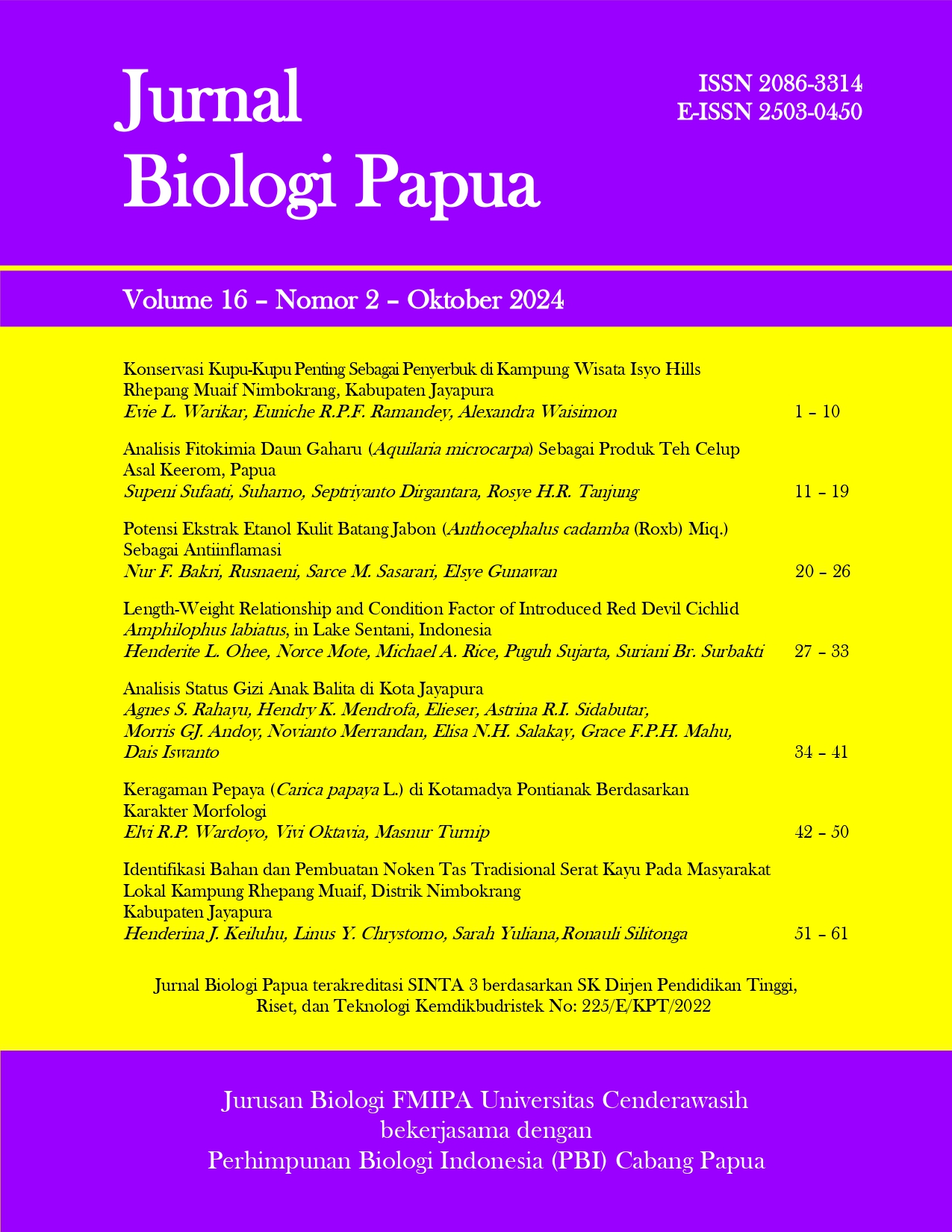
Analisis Fitokimia Daun Gaharu (Aquilaria microcarpa) Sebagai Produk Teh Celup Asal Keerom, Papua

https://doi.org/10.31957/jbp.3363
Keywords:
agarwood leaves , antioxidants , Papua, phytochemicals, tea bagsAbstract
This study explores the phytochemical composition and antioxidant potential of Agarwood (Aquilaria microcarpa) leaves from Keerom, utilized in tea bags. Phytochemical analysis of ethanol extracts revealed flavonoids, alkaloids, steroids/triterpenoids, tannin gallate, and saponins. Total phenol content measured at 1.31 g GAE/100 grams, with total flavonoids at 210 mg QE/100 grams. The extract demonstrated robust antioxidant activity with an AAI value of 1.23, surpassing ascorbic acid (AAI value of 13.37). Mangiferin and quercetin were identified among the compounds in the leaves, highlighting their potential health benefits.
Downloads
References
Ali, S.K., S.M. Mahmoud, S.S. El-Masry, D.H.M. Alkhalifah, W.N., Hozzein, and A.M. Aboel-Ainin. 2022. Phytochemical screening and characterization of the antioxidant, anti-proliferative and antibacterial effects of different extracts of Opuntia ficus-indica peel. Journal of King Saud University–Science. 34(7): 102216.
Farnsworth, N.R. 1966. Biological and phytochemical screening of plant. Journal of Pharmaceutical Sciences. 55: 874–875.
Fidrianny, I., H. Nurfitri, and Sukrasno. 2015. In vitro antioxidant activities, phenolic, flavonoid and carotenoid content from different polarity extracts of five Citrus peels using DPPH and cuprac method. Journal of Chemical and Pharmaceutical Research. 7: 1525-1531.
Gunasekara, S., A. Kinghorn, G. Cordell, and S. Farnsworth. 1981. Plant anti cancer agent xix. Constituent of Aquilaria malaccensis. Journal of Natural Product. 44(5): 569–572.
Harborne, J.B. 1989. Methods in Plant Biochemistry. In: Dey, P.M. and Harborne, J.B., Eds., Plant Phenolics, Academic Press, London.
Harfinda, E.M., S. Normagiat, dan G. Hardiansyah. 2017. Potensi senyawa metabolit sekunder daun Aquilaria sp. asal Kalimantan Barat untuk pembuatan teh herbal. Seminar Nasional Ilmu Pengetahuan dan Penerapan Teknologi 2017. Pontianak, 23-24 Mei 2017. pp: 29-35.
Heim, K.E., A.R. Tagliaferro, and D.J. Bobilya. 2002. Flavonoid antioxidants: Chemistry, metabolism and structure-activity relationships. Journal of Nutritional Biochemistry. 13: 572-584.
Ibrahim, A. H., S. Al-Rawi, A.M.S. Majid, N.N.A. Rahman, K.M.A Salah, and M.O.A. Kadir. 2011. Separation and fractionation of Aquilaria malaccensis oil using supercritical fluid extraction and the cytotoxic properties of the extracted oil. Procedia Food Science. 1(11): 1953–1959.
James P.B., J. Wardle, A. Steel, and J. Adams. 2018. Traditional, complementary and alternative medicine use in Sub Saharan Africa: a systematic review. BMJ Global Health. 3: e000895.
Kementerian Kesehatan Republik Indonesia. 2017. Farmakope Herbal Indonesia Edisi II. Direktorat Jenderal Pengawasan Obat dan Makanan. Jakarta.
Kristanti, A.N., M. Tanjung, dan N.S. Aminah. 2018. Review: Secondary metabolites of Aquilaria, a Thymelaeaceae Genus. Mini-reviews in Organic Chemistry. 15: 36-55.
Liu, Y., H. Chen, Y. Yang, J. Wei, H. Meng, W. Chen, J. Feng, B. Gan, X. Chen, Z. Gao, J. Huang, and B. Chen. 2017. Whole-tree agarwood inducing technique: An efficient novel technique for producing high-quality agarwood in cultivated Aquilaria sinensis trees. Molecules. 18: 3086.
Molyneux, P. 2004. The use of the stable free radical diphenylpicryl-hydrazyl (DPPH) for estimating antioxidant activity. Songklanakarin Journal of Science and Technology. 26: 211–219.
Narayanankutty, A., K. Kunnath, A. Alfarhan, R. Rajagopal and V. Ramesh. 2021. Chemical composition of Cinnamomum verum leaf and flower essential oils and analysis of their antibacterial, insecticidal, and larvicidal properties. Molecules. 26(20): 6303.
Petkova, N., L. Ivanova, G. Filova, I. Ivanov, and P. Denev. 2017. Antioxidants and carbohydrate content in infusions and microwave extracts from eight medicinal plants. Journal of Applied Pharmaceutical Science. 7(10): 55-61.
Ryu, H.W., J.H. Lee, J.E. Kang, Y.M. Jin, and K.H. Park. 2012. Inhibition of xanthine oxidase by phenolic phytochemicals from Broussonetia papyrifera. Journal of the Korean Society for Applied Biological Chemistry. 55: 587– 594.
Scherer, R., and H.T. Godoy. 2009. Antioxidant activity index (AAI) by the 2,2-diphenyl-1-picrylhydrazyl method. Food Chemistry. 112: 654-658.
Supriatna, D., Y. Mulyani, I. Rostini, dan M.U.K. Agung. 2019. Aktivitas antioksidan, kadar total flavonoid dan fenol ekstrak metanol kulit batang mangrove berdasarkan stadia pertumbuhannya. Jurnal Perikanan dan Kelautan. 10(2): 35–42.
Tanjung, R.H.R., Suharno, dan M. Warpur. 2008. Isolation of fungi from Aquilaria sp (gaharu) infected tissue grow in Papua. Paper Presented on the 9th New Guinea Biology Conference. Jayapura, 24–26 Juli 2008.
Thitikornpong, W., B. Ongpipattanakul, C. Palanuvej, and Ruangrungsi. 2018. Pharmacognostic spesification and mangiferin content of Aquilaria crassna leaves. Pharmacognosy Journal. 10(2): 293-298.
Utami, Y.P., S. Sisang, dan A. Burhan. 2020. Pengukuran parameter simplisia dan ekstrak etanol daun patikala (Etlingera elatior (Jack) R.M.Sm.) asal Kabupaten Enrekang Sulawesi Selatan. Majalah Farmasi dan Farmakologi. 24(1): 5-10.
Wang, S., Z. Yu, C. Wang, C. Wu, P. Guo, and J. Wei. 2018. Chemical constituents and pharmacological activity of agarwood and Aquilaria plants. Molecules. 23(2): 342. DOI: 10.3390/molecules23020342.
Yabalak E., F. Ibrahim, E.A.E. Eliuz, A. Everest, and A.M. Gizir. 2022. Evaluation of chemical composition, trace element content, antioxidant and antimicrobial activities of Verbascum pseudoholotrichum. Plant Biosystems–An International Journal Dealing with all Aspects of Plant Biology. 156(2): 313-332.
Yulizah, R., J.S. Rahajoe, A.D. Fefirenta, dan A.D. Nugroho. 2022. The population and distribution of agarwood producing tree (Aquilaria malaccensis) in Riau Province. Reinwardtia. 21(1): 1–11.
Downloads
Published
Issue
Section
License
1. Copyright Policy
Jurnal Biologi Papua is committed to promoting the dissemination, accessibility, and responsible reuse of scholarly research in biology and related disciplines.
Under this policy, authors retain copyright ownership of their published articles and grant Jurnal Biologi Papua the non-exclusive right of first publication.
Authors retain the right to use, distribute, reproduce, and share their scholarly work in accordance with the applicable publication license.
The journal acknowledges the intellectual contributions of authors and respects their moral rights, including the right to be properly identified as creators of their work.
2. Publication License
Articles published under this policy are distributed under the Creative Commons Attribution 4.0 International License (CC BY 4.0).
License URL: https://creativecommons.org/licenses/by/4.0/
Under this license, users are permitted to:
-
Share: Copy and redistribute published articles in any medium or format.
-
Adapt: Remix, transform, and build upon published materials for any purpose, including commercial purposes.
-
Redistribute: Make articles available through repositories, websites, databases, and other scholarly platforms.
These permissions are subject to the Creative Commons Attribution 4.0 International License.
Users must provide appropriate credit to the original authors, include a link to the license, and indicate whether changes have been made.
Reuse must not imply endorsement by the authors or publisher.
3. Rights of Authors
Authors publishing in Jurnal Biologi Papua retain the following rights:
-
Copyright ownership of their original scholarly work.
-
The right to distribute and share their published articles.
-
The right to deposit their articles in institutional or subject repositories.
-
The right to reuse their work in subsequent scholarly publications, subject to appropriate acknowledgment and applicable ethical standards.
-
The right to share their work for teaching, research, academic collaboration, and other lawful purposes.
Authors must acknowledge the original publication in Jurnal Biologi Papua when distributing or reusing the published version.
4. Rights of the Publisher
Authors grant Jurnal Biologi Papua the non-exclusive right to publish, disseminate, archive, and preserve accepted manuscripts.
The journal may reproduce and distribute the published version through its official website and authorized indexing, archiving, and scholarly dissemination services.
The publisher is responsible for maintaining the integrity of published content and accurately displaying copyright and licensing information.
5. Open Access Policy
Jurnal Biologi Papua supports immediate open access to scholarly research.
Articles published under this policy are freely accessible to readers without subscription requirements or access fees.
The journal encourages the responsible dissemination and reuse of published research to support scientific progress, academic collaboration, and the broader exchange of knowledge.
Published content may be accessed, downloaded, shared, and reused in accordance with the applicable Creative Commons license.
6. Third-Party Materials
Authors are responsible for ensuring that all materials included in their manuscripts comply with applicable copyright and intellectual property laws.
Permission must be obtained when required for the use of third-party figures, photographs, tables, illustrations, or other copyrighted materials.
Materials excluded from the article's Creative Commons license must be clearly identified with their applicable copyright and permission notices.
The journal's publication license does not override the rights of third-party copyright holders.
7. Repository and Self-Archiving Policy
Authors are permitted and encouraged to deposit and share their published articles through institutional repositories, academic repositories, and personal or institutional websites.
Authors must provide appropriate acknowledgment of the article's original publication in Jurnal Biologi Papua, including its citation information and DOI where available.
Repository deposits and subsequent distribution must comply with the license applicable to the relevant version of the article.
8. Licensing Information and Article Metadata
The applicable copyright holder and publication license should be clearly identified on each published article's webpage.
Where supported, licensing information should also be included in article metadata and the published PDF.
The journal is committed to maintaining accurate and consistent licensing information across its online publishing platform and scholarly indexing services.
9. Policy Application and Previously Published Articles
This policy applies to manuscripts accepted following its formal adoption by the journal and publisher.
Articles published before the adoption of this policy remain subject to the copyright arrangements and licenses applicable at the time of their publication, unless a valid change is authorized by the relevant rights holders.
The journal will not apply a new license retroactively without the necessary authorization.
10. Policy Commitment
Jurnal Biologi Papua is committed to transparent copyright arrangements, responsible open access publishing, and respect for intellectual property rights.
The journal will periodically review its copyright and licensing practices to maintain consistency with recognized standards of scholarly communication.
References
Creative Commons Attribution 4.0 International License: https://creativecommons.org/licenses/by/4.0/
Directory of Open Access Journals (DOAJ): https://doaj.org/apply/copyright-and-licensing/











